


The Top 10 Ways EFT Changed my Life and Relationship to Food
Many people are curious about my personal story. So I thought I would share a bit more about myself and how the techniques I use in my program helped change my life and relationship to food.
1. I no longer crave chocolate (or any food) compulsively
2. I do not binge on food to the point of sedation
3. I am not on a diet
4. My weight doesn’t yo-yo up and down
5. I’ve stayed at my current weight for more than three years now. Give or take a few pounds
6. I don’t spend all day obsessing about food or worried about how much I weigh. (well, not really, I AM still a girl) :-)
7. I don’t have to TRY to eat healthy, I just do. No willpower involved.
8. I used to park my booty in front of the fridge after a bad day, and now, I go for a run
9. I’ve gone from super insecure and stuck in a bad relationship to feeling like I can RULE THE WORLD …. No really, I do.
10. AND MOST IMPORTANTLY, in the process of it all, I developed a system and strategy to help women do the exact same.
Love Yourself!
XO
Brittany
2435 Polk St. Ste #8 San Francisco, CA, 94109 USA
watkinsventures@gmail.com • (415) 230-9406
Avoid Holiday Weight Gain- Workshop Sausalito
Do you know the holidays can add 10 pounds? If you want to learn how to control your weight by controlling your MIND around food and cravings come join me in Sausalito on December 14th
You’ll Learn how to:
• Reprogram your mind and your relationship to food
• Shift your limiting beliefs that hold you back from success
• Tame your inner rebel
• Feel excited and motivated to exercise
Toss out your diet pills, diet plans and diet mentality, together we will re-align your psychology so losing weight comes naturally.
Bring your favorite vice with you (e.g., chocolate, potato chips, cookies) everyone will experience results!
When: December 14th 2011 6:30pm-8:30pm
Where: Sausalito
How Much: $20
Email or call for questions brittany@brittanywatkins.com or 415-230-9406
Avoid Holiday Weight Gain- Workshop SF
Do you know the holidays can add 10 pounds? If you want to learn how to control your weight through the holidays come learn from the powerful duo of
Brittany Watkins- Weight Loss Coach and Mind programming Extraordinaire
Caitlin Weeks – Holisitic Nutritionist www.grassfedgirl.com
Toss out your diet pills, diet plans and diet mentality, in this class Brittany and Caitlin will show you how to:
Eat food and not gain weight over the holidays AND how to re-align your psychology so losing weight comes naturally!
Brittany will teach you how to
• Control your weight by reprogramming your mind and your relationship to food
• Shift your limiting beliefs that hold you back from success
• Tame your inner rebel
• Feel excited and motivated to exercise
Caitlin will cover
• How to lose weight without hunger
• Which diet foods are making you fat
• Increase your energy and avoid that 3 pm office slump
• How depression and diabetes are linked to eating inflammatory foods
Bring your favorite vice with you (e.g., chocolate, potato chips, cookies) everyone will expereince results by eliminating their cravings!
When: December 10th 2011 11am-1pm
Where: 2435 Polk St Suite 8
San Francisco, CA 94109
How Much: $20
Email or call for questions brittany@brittanywatkins.com or 415-230-9406
Listen to a Craving Call! – MP3

We had so much fun on last week’s call! We kicked all sorts of unhealthy cravings to the curb… chocolate chip cookies, brownie fudge sunday’s, and burritos!
Denise, a former client, gave us an update after working with me TWO years ago! Listen to the MP3 to hear how she is doing with her cravings now …
http://www.freeconference.com/Recordings/ConferenceRecording-11029623-338359.mp3
For faster listening, I’ve included edits. Skip around the recording if you don’t have time to listen to the whole thing!
3:00 Denise Testimonial – 2 years later
17:41 Technique How-to
39:07 First reactions to food after using Skinny Genes Solution
49:22 Second reactions to food after using SGS
1:01:33 Final Results after using SGS
The Tapping Solution- (a documentary about EFT)
If you want to know more about EFT, the method I use to help people overcome emotional issues that cause weight gain, watch this trailer. You can also visit their website for more information: www.thetappingsolution.com
The Genie in your Genes
If you’d like to read more about the science of these methods and how they can change your genetic make-up, here is a great book on it. http://genieinyourgenes.com/
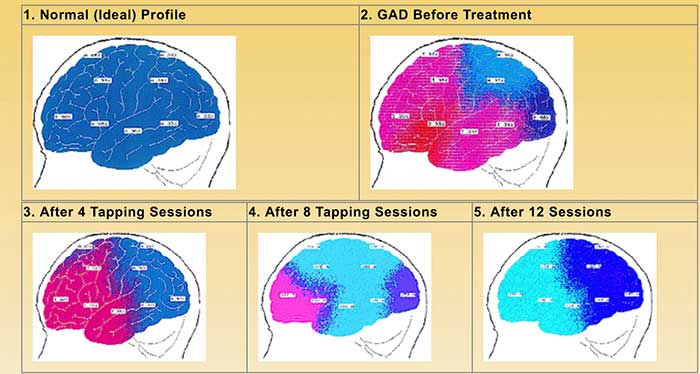
Why Tapping Works: Speculations from the Observable Brain
Ronald A. Ruden, M.D., Ph.D.
A new therapy for phobias, PTSD, addictive behaviors and other psychological issues was first described by Dr. Roger Callahan and involves thought activation of the problem followed by tapping on certain acupoints in a specific sequence. For most cases, the problems were reportedly cured in a matter of minutes. We speculate on a neuroanatomical and neurophysiological mechanism for this technique.
We propose that tapping and other sensory stimulation increase serotonin in both the prefrontal cortex and the amygdala. The success of this technique requires that glutamate be first increased in the circuit by activating affect. We suggest the name ‘Affect Activation/Sensory Stimulation’ to encompass this general approach. AA/SS represents a paradigm shift for the treatment of these problems.
INTRODUCTION
In 1986, Dr. Roger Callahan discovered that tapping under the eye of an individual with a water phobia immediately and permanently cured this problem (Callahan, 2001). Tapping on specific traditional Chinese medicine acupoints in a specific sequence literally appears to throw a switch. After a successful treatment, disturbing thoughts decrease and the phobic response disappears, for good!
A large study that involved over 29,000 patients was conducted using these tapping procedures. The remarkable results (Andrade & Feinstein, 2003) covered a wide range of problems, such as specific phobias, panic disorders, post-traumatic stress disorders, acute stress disorders, and anxiety-depressive disorders. This method was successful in 76% of the subjects.
A neurobiological model must explain several characteristics of this therapy:
• Why must the distress be activated before it can be treated?
• Why is the treatment specific to one phobia at a time?
• Why does the same protocol work for many different problems?
• Why does the distress appear to diminish during tapping (Wolpe 1958)?
• What is the transduction event that converts tapping into a biological event in the brain?
• How and why does this treatment produce a rapid and permanent change in an individual’s response to the distressful thought?
THE AMYGDALA AND EMOTION
Neuroimaging (Phan, Wager, Taylor & Liberzon, 2004), lesional (Cousens & Otto, 1998), (LeDoux, Ciccheti, Xagoraris & Romanski,1990), (Blanchard & Blanchard, 1972) and neuroanatomic (Sah, Farber, Lopez De Armentia & Powers, 2003) studies point to the amygdala as the final common pathway for expression of emotions. The amygdala is well suited for this job, receiving input from the hippocampus, the prefrontal cortex, the thalamus, midbrain nuclei, and other cortical and subcortical areas (Maren, 2001). The amygdala is made of several nuclei; the basolateral (BL), the lateral (LA) and the basomedial (BM) make up the basolateral complex, the BLA (Maren, 2001). The lateral nucleus receives the information from other areas. The associations between a conditioned stimulus and response are believed to be stored in the BLA, and when appropriate, a signal is sent to the Central (Ce) nucleus of the amygdala. Activation of the Ce is necessary to produce the behavioral, autonomic and endocrine components of an emotional response by activating other areas of the brain, including projecting neurons to the nucleus accumbens, locus coeruleus, paraventricular nucleus, the hypothalamus, and the prefrontal cortex.
ENCODING FEAR
Of all the emotional states we experience, fear is the most primitive and powerful. If we understand how a fear response is disrupted, we may be able to understand how tapping works. Phobias are characterized by a persistent, irrational and excessive fear of objects or situations like bugs, colors, numbers, light, dark, bridges, tunnels, elevators and planes. Since no imminent danger is associated with these objects or situations, they can be considered conditioning stimuli (CS). A special genetic and environmentally modulated neurobiological landscape is necessary to encode a phobia (Gapenstand, Annas, Ekbolm, Oreland & Fredrikson, 2001). Treatment that disrupts the encoded phobic response may therefore extinguish it forever.
Phobias are learned and as such are fundamentally different than responses to innate fears. A fear response is generated by sensing an innate fear, also called Unconditioned Fear Stimuli (UFS). Such stimuli reflect the fear of being killed and are hard wired in the brain, including fear of the unknown (novel situations), heights (falling), closed spaces (being trapped), open spaces (no place to hide), creepy crawly things (land based predators) and something coming out of our visual fields (air based predators). These survival stimuli do not reach consciousness because details are unimportant: only the emotion of fear is experienced, mandating avoidance. Accordingly, the thalamus, which is the first sensory connection in the brain, has direct projections to the amygdala (Doron & LeDoux, 1999).
A phobia is generated by an innate (unconditioned) fear stimulus leading to a fear response in the presence of another object or situation. For example, traveling over a bridge (CS), you look down and see the height (UFS). The height causes fear, leading to a phobia of bridges.
NEUROPHYSIOLOGY
Animal studies of conditioned fear suggest that glutamate agonists enhance learning and glutamate antagonists inhibit the learning of the fear response in mice (Myers & Davis, 2002). Glutamate, an excitatory amino acid, is involved in activating genes that are necessary for memory storage and retrieval (Reidel, Platt & Micheau, 2003). These genes alter the wiring and firing of neurons. This implies that glutamate is released locally where learning takes place. GABA, an inhibitory amino acid, inhibits glutamate and, as such, GABA agonists inhibit fear conditioning and GABA antagonists accelerate it (Myers & Davis, 2002).
EXTINCTION TRAINING
Chemical approaches have extinguished fear conditioning in animals using infusions of anisomycin, a protein synthesis inhibitor (Nader, Schafe & LeDoux, 2000) and the GABA agonist muscimol (Muller, Corodimas, Feidel & Ledoux, 1997). The conclusions were that a fear response could only be disrupted shortly after being activated, that protein synthesis was involved, and that a GABA agonist could temporarily disrupt the fear response. In another experiment, depletion of serotonergic neurons prevented extinction of the fear. These results imply that serotonin plays a role in extinction (Fiberger, Lepiane & Phillips, 1978).
Research has documented a group of inhibitory neurons intercalated between the BLA and the central nucleus (Ce) of the amygdala as the potential mechanism for this fear extinction. (Pare, Royer, Smith & Lang, 2003).
WHY TAPPING WORKS
We believe that “affect activation” is the critical aspect for success of the tapping method and propose that during affect activation, glutamate is locally released in areas corresponding to the neural circuit that initially encoded the conditioned fear. Without local release of glutamate, no amount of tapping will be effective. Tapping or other sensory stimulation (massage, eye movement, etc.) then causes a global, non-specific release of serotonin via ascending pathways
More information about the methods used in the Skinny Genes Program
What is Emotional Freedom Technique?
Emotional Freedom Techniques (EFT) is an emotional, needle free version of acupuncture that is based on new discoveries regarding the connection between your body’s subtle energies, your emotions, and your health. It was discovered in 1981 my Dr. Roger Callahan a cognitive psychologist and Gary Craig. It is based on clinical psychology and acupressure. It quickly and effectively conquers phobias, anxiety, stress, compulsions, and addictions by literally tapping on specific acupressure points while saying simple affirmations. The process is easy to memorize and is portable so you can do it anywhere. EFT has been reported successful in thousands of cases covering a huge range of emotional, health and performance issues.
What is (EMDR) Eye movement desensitization and reprocessing?
EMDR is a natural, safe way to release stress and trauma. EMDR simulates REM sleep, your body’s own natural release system. This powerful quick release happens without reliving the trauma. Accessing the whole mind/body system while in an awake state allows you to be in control of your own journey. EMDR empowers individuals to live a happy, productive life by releasing negative belief systems, negative thought forms, and emotions—all of which contribute to emotional stress.
What Makes EMDR Work?
EMDR, physiologically and psychologically, opens up the neuropath ways where the memories of our personal and inherited traumatic experiences are trapped. Neurons in the brain stem switch on the same way they do in REM sleep, causing communication at the cellular level throughout the body. Energy confined at the cellular level by emotional or physical trauma is thus accessed allowing energy discharge through a fast eye blinking process. Clients release issues and emotions at a comfortable rate without reliving incidents.
What is Neurolinguistic Reprogramming?
Neurolingustic Reprogramming is a general approach to modeling human behavior, aiding personal growth, and assisting in communication. It was developed in the early 1970s as a set of techniques derived from behaviors observed in effective psychotherapists, and since then, it has been generalized and utilized in a wide range of fields. The term refers to the three areas that Neurolingustic Reprogramming sees as giving birth to the subjective experience: the mind, language patterns, and the programming that organizes our perceptions and thoughts.
Neurolingustic Reprogramming is a way of approaching personal development, and it can be extended to improve one’s interpersonal skills. In essence, it gives people a set of tools through which they can live richer, fuller lives, drawing on observed behaviors from others to deduce what these tools might be. It allows you to change, adopt or eliminate behaviors, as you desire, and gives you the ability to choose your mental, emotional, and physical states of well-being.